 Nederlands
Taping your own knee
Do you suffer from a nagging pain around your kneecap while running? Or does your knee feel a bit unstable after a previous twisting? Many people in our practice ask us if it makes sense to tape up their knee. The answer is often yes, but as part of a wider approach. Tape can give that extra bit of support and confidence you need to keep moving.
Why tape your knee?
Taping the knee is often used to reduce pain and improve joint function. When you apply tape correctly, it stimulates the skin and underlying sensors. This improves ‘proprioception’: your brain is more aware of the position of your knee. As a result, you control your muscles better and the knee feels more stable.
In addition, tape can help steer the kneecap (patella). In many knee problems, the kneecap does not track quite right in the groove of the thigh, causing irritation. A properly applied tape can subtly correct the kneecap, reducing pressure and allowing you to move with less pain.
Sports taping vs medical taping
Before you run to the shop, it is important to know that there is a big difference between white, non-stretchable sports tape and coloured, elastic tape (also called kinesio tape or medical tape).
White sports tape is rigid and does not stretch. We use this tape mainly when we want to restrict or block a joint movement, for example after an acute ankle sprain. It gives a lot of strength, but it can impede blood flow if it is too tight and it restricts your range of motion. This is usually not what you want with an overused knee that does need to keep moving.
Medical tape (kinesio tape) is elastic and resembles human skin in thickness and stretchability. This tape lifts the epidermis slightly, creating more space in the area below it (the subcutaneous skin). This promotes blood flow and lymph drainage, which supports recovery. Because the tape moves with you, you maintain your full range of motion. For most knee problems, such as running or overuse, we therefore use this elastic variant.
When does taping make sense?
We often recommend taping as support in specific situations. However, it is never a substitute for training or treatment.
In running and sports
For runners with incipient irritation around the kneecap, tape can provide relief. The tape absorbs some of the forces that normally come to bear on the tendon tissue. We as sports physiotherapist in such a case, look not only at the knee, but also at your running technique and footwear.
In case of overuse (Runners Knee)
A common complaint where we use taping is the runners' knee. This involves irritation on the outside of the knee or around the kneecap due to repetitive strain. Tape can reduce friction, lowering acute pain and allowing you to start exercise therapy sooner.
Taping your own knee
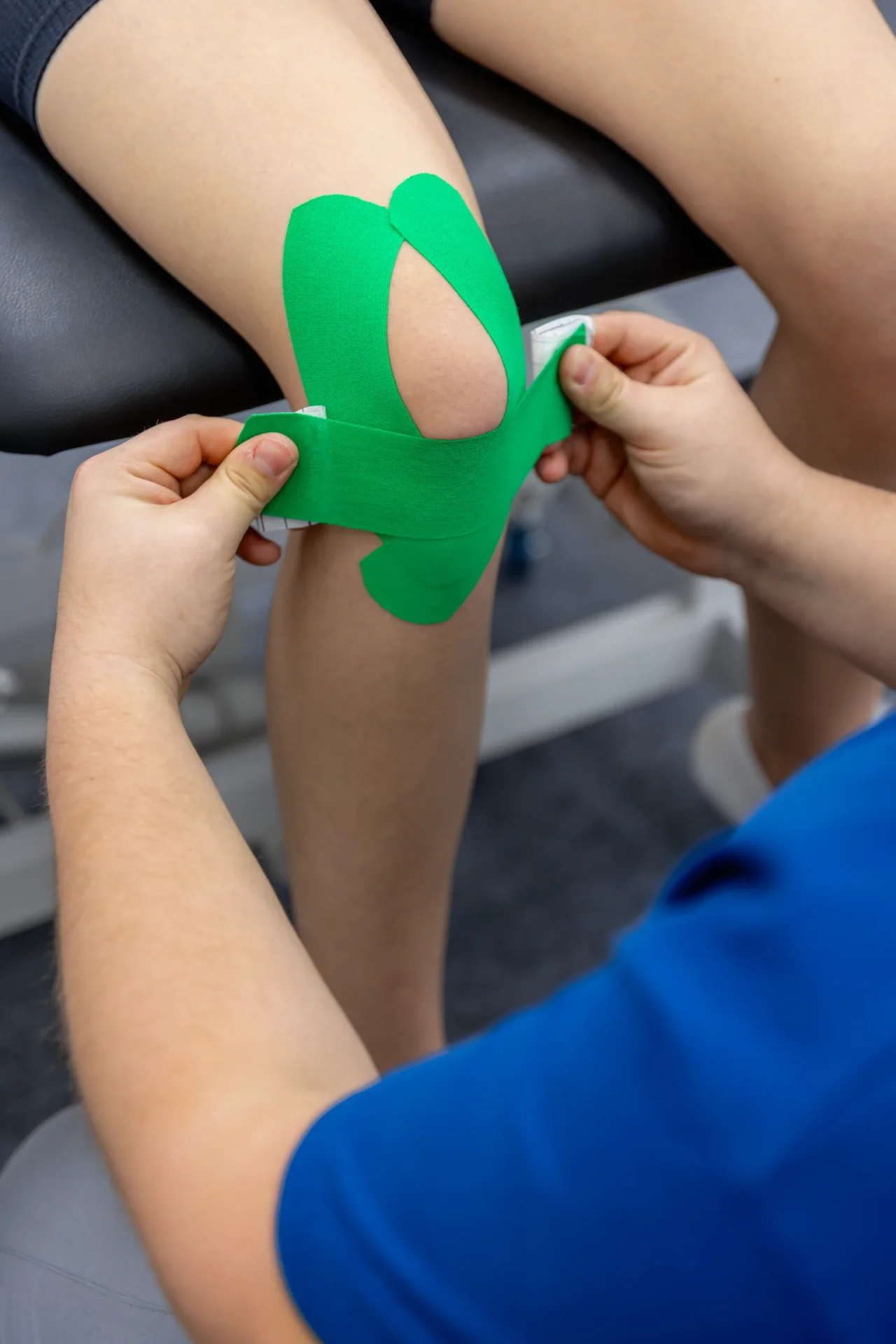
Want to tape your knee yourself for extra stability? Below we describe a basic application for general kneecap support with elastic kinesio tape.
Note: Have you never taped before or are you in doubt about the cause of your pain? If so, have a physiotherapist look at it first. Incorrect taping can sometimes make symptoms worse.
1. Preparation
Make sure you have clean, dry skin without any body lotion or oil. If you have a lot of hair on your legs, it is wise to shave or trim the area around the knee. The tape will then adhere better and removal will be a lot less painful.
2. The application
Sit on a chair and bend your knee about 90 degrees. Take two strips of tape about 15 to 20 centimetres long. Cut the corners round, this will prevent the tape from coming off quickly due to friction from your trousers.
Tear the paper of the first tape down the middle and fold it outwards, leaving the middle piece of tape (the ‘anchor’) free. Tape this middle piece under your kneecap with slight stretch. Then run the ends up along the sides of your kneecap without stretching, in a U-shape. Rub the tape on well.
You can possibly use the second strip for extra correction or stability, depending on where your pain is. A common technique is to stick this second strip over the sore on the outside, again with slight stretching in the middle and no stretching at the ends.
Taping alone is not enough
It is tempting, when in pain, to immediately reach for the roll of tape and cheerfully continue exercising. However, be aware that tape is only symptom relief. It does not address the cause of the complaint - often reduced muscle strength, stiffness or an incorrect movement pattern.
To really get rid of your symptoms, you need to make the tissue more taxable. You do this through targeted exercises. Stronger buttock and thigh muscles will eventually ensure that your knee won't need that tape at all.
Common mistakes and risks
Although kinesio tape is relatively safe, we sometimes see it go wrong. The most common mistake is applying the tape with too much stretch. This can irritate the skin, leading to red blisters or stretch marks. Certainly the ends (the anchors) should always be applied absolutely without stretch.
In addition, you should never tape on damaged skin, wounds or in cases of acute thrombosis. Do you have sensitive skin or are you allergic to plasters? Then first test a small piece of tape on your arm before taping your entire knee. Do you get an itching or burning sensation under the tape? Then take it off immediately.
Need help with Fysio Fitaal?
Is self-taping not working well, or do symptoms keep coming back despite support? Then it is wise to make an appointment at Fysio Fitaal. We have locations in Tilburg Reeshof, Zuid, West and Noord.
Our therapists can teach you how to tape specifically for your knee. We also look directly at the underlying cause and draw up an exercise schedule to get you fit again as soon as possible.

Frequently asked questions about taping your knee
How long can the tape stay in place?
Medical tape is waterproof and can usually stay on for 3-5 days. You can simply shower with it. Do gently pat the tape dry after showering instead of rubbing it, otherwise it will roll up.
Is sports tape the same as medical tape?
No, sports tape is white and non-stretchable, meant to secure joints. Medical tape (kinesio tape) is elastic and coloured, meant to support movement and stimulate blood flow.
Does taping also help with osteoarthritis pain?
Yes, with knee osteoarthritis, taping can help cushion the pain. By lifting the skin slightly and improving control, many people with wear and tear symptoms experience relief while walking.
Should I shave my leg before taping?
It is recommended, though. Tape adheres better to skin than to hair. Moreover, removing the tape is a lot less painful if your leg is shaved.
Why are there different colours of tape?
Although there are many theories about it (such as blue for cooling and red for activating), technically there is no difference between the colours. Adhesion and elasticity are the same for all colours of the same brand. So feel free to choose the colour you like.
Related complaints

Kneecap dislocated (Patella luxation)
It is one of the most painful and drastic experiences on the sports field or during...
Medial band knee(MCL)
An injury to the inner ligament of the knee requires accurate diagnosis and a...
Tendinitis knee
You often notice it at the first step out of bed or while climbing stairs: a...