 Nederlands
Kneecap dislocated (Patella luxation)
It is one of the most painful and drastic experiences on the sports field or during an unfortunate fall: your kneecap dislocates. The shock is often well in the air. Your knee looks different, hurts a lot and you can no longer stand on it. Fortunately, in many cases this injury recovers well with the right treatment and rehabilitation.
At Fysio Fitaal, we regularly see people with a kneecap dislocated, in medical terms a patella luxation mentioned. Whether it happens during a game of football, due to a fall or due to a congenital predisposition, we will help you regain confidence in your knee and become strong again.
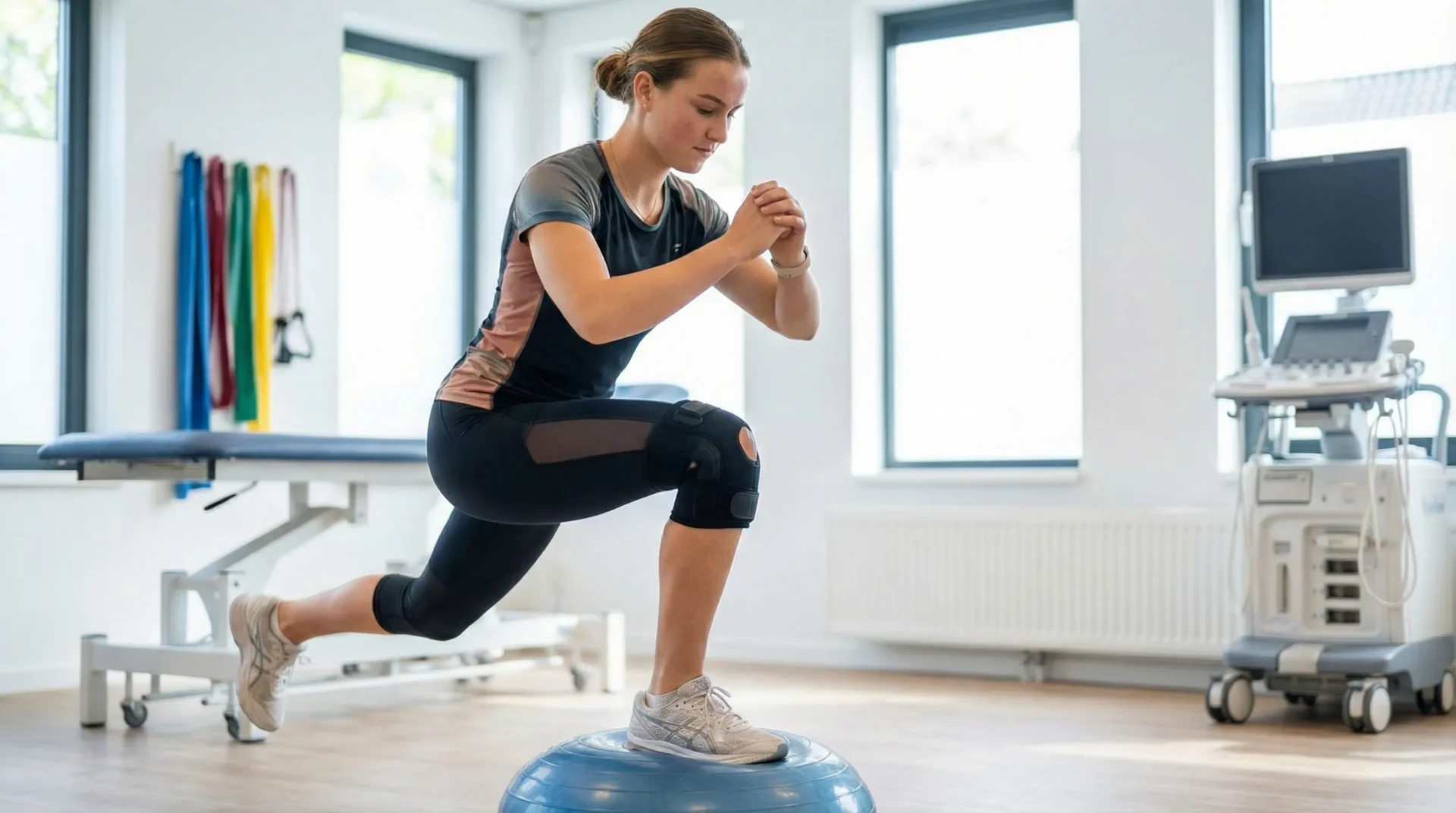
What is a patella luxation?
The kneecap (patella) is located at the front of the knee and normally slides smoothly into a groove (groove) of the femur. In a patella luxation, the kneecap shoots out of this groove, almost always to the outside of the knee.
This is different from a ‘knee dislocation’ (where the lower leg shifts relative to the upper leg), which is a much more serious and rare injury. In a kneecap luxation, the knee ligaments stretch, causing swelling and pain. Often, the kneecap shoots back into place on its own, but sometimes it needs to be repositioned by a doctor or nurse.
Causes and symptoms
A kneecap dislocated often occurs during sports, for example when you bend and twist the knee at the same time. We often see this in sports with a lot of hooding and twisting movements, such as football or hockey. A direct fall can also be the cause.
The symptoms are often very obvious:
- The kneecap sits as a thick bump on the outside of the knee.
- There is a lot of pain and you cannot lean on the leg.
- The knee quickly thickens due to fluid accumulation in the joint.
Why does a knee dislocate?
Not everyone's kneecap dislocates as easily. There are certain risk factors that increase the likelihood. Teenagers in the growth spurt, especially girls, are more likely to suffer from this injury.
Other contributing factors include:
- The shape of the kneecap or gutter (if it is shallow, the disc slides out more easily).
- The position of the legs (e.g. X-legs).
- Knee ligaments too slack (hyperlaxity).
Diagnosis and examination
If your kneecap has been dislocated, it is important to check that there is no additional damage. This is because sometimes a piece of bone or cartilage breaks off when the kneecap shifts. An X-ray is often taken in hospital to rule this out.
At Fysio Fitaal, we use ultrasound diagnosis and examination to get a good view of the soft tissue around the knee, such as the ligaments. This allows us to see exactly what is going on and adjust our treatment plan accordingly.
Recovering from a dislocated kneecap
Recovery proceeds in several stages. In most cases, surgery is not immediately necessary and the knee can recover with the right guidance.
Phase 1: The acute phase (Week 0-2)
Immediately after the injury (or after the kneecap is reset), rest is essential. You will often be fitted with a splint, plaster cast or solid brace to give the knee rest. This allows the stretched ligaments to recover.
- Cool the knee to reduce pain and swelling.
- Put the leg up as you sit.
- Load the leg as little as possible; use crutches if necessary.
Phase 2: Mobilisation and light exercises (Weeks 2-6)
After about 1-2 weeks, the plaster cast or splint is often replaced by a special knee brace. This brace provides support, but allows you to carefully start bending and loading the knee again. In this phase, you often start with gentle exercises under the supervision of the physiotherapist. These include tightening the thigh muscles (quadriceps) and carefully lifting the stretched leg.
Phase 3: Build up to load (After 6 weeks)
After about six weeks, there is often a check-up in hospital and the brace may usually be tapered off. The focus now shifts to strengthening the muscles around the knee and hip. Strong muscles, especially the thigh muscles, are essential to prevent the kneecap from dislocating again.
Treatment at Fysio Fitaal
At Fysio Fitaal, we guide you intensively during your rehabilitation. Because a displaced kneecap has a big impact on confidence in your body, we pay a lot of attention to stability and anxiety-free movement.
Our treatment focuses on:
- Mobility: Making sure the knee can bend and stretch smoothly again.
- Strength: Training the quadriceps (front thigh) and glutes specifically.
- Stability: Exercises to improve knee control so you no longer sag.
- Sports-specific: Want to play football or run again? We will tailor a plan to get you safely back to your old level.
Do you have general knee complaints or residual complaints such as the patellofemoral pain syndrome? Even then we can help you.
Make an appointment at Fysio Fitaal
Has your kneecap been dislocated and are you looking for professional guidance in your recovery in Tilburg? The team at Fysio Fitaal is here for you. We will help you move strongly and confidently again. Make an appointment directly at one of our locations.
Frequently asked questions
How long does recovery from a dislocated kneecap take?
Full recovery often takes several months. For the first 6 weeks, you usually wear a brace or splint. This is followed by a period of strength training. Resumption of work or light activities often says 6 to 12 weeks, but full sports recovery may take longer.
Can a dislocated kneecap recover on its own?
Yes, in many cases the kneecap slides back on its own. Tyre damage also often recovers with rest and physiotherapy. However, if the kneecap dislocates very frequently, surgery may be needed to restore stability.
What should I do if my knee dislocates?
Try to stay calm. If the kneecap does not slide back on its own, you can try gently stretching the leg, sometimes it will slide back. Does this not work or are you in a lot of pain? Then call your GP or go to the emergency room. Call 112 immediately if you really can't lean on the leg and are in a lot of pain.
Can I keep playing sports after a patella luxation?
In the first weeks, rest is necessary. After the rehabilitation period, when muscle strength and stability are restored, you can resume sports. It is important to build this up slowly under supervision to prevent another luxation.
Is this common in children?
Yes, kneecap dislocation is relatively common in teenagers, especially during the growth spurt. Girls suffer from this more often than boys.
Related exercises


Related complaints

Quadriceps activation failure
Not being able to properly tighten your upper leg (quadriceps) brings difficulties during a...

Osgood Schlatter
In active children and teenagers, this may be accompanied by specific physical complaints. Do you have...
Medial band knee(MCL)
An injury to the inner ligament of the knee requires accurate diagnosis and a...
Make an appointment at Fysio Fitaal
We work from multiple locations in Tilburg, always close by for professional and accessible physiotherapy. Fill in the contact form and we will contact you soon. Together, we will work on your recovery!