 Nederlands
Overloaded knee
You might recognise it: you've been training nicely for that half marathon, or you've been working hard in the garden for a day, and the next day your legs feel heavy. But that one nagging pain in the knee won't go away. You are now suffering from left knee pain, a stitch in the knee at each step, or tired knees who don't want to get going in the morning: an overworked knee can hinder your daily life considerably.
At Fysio Fitaal, we see people with these symptoms every day. The good news is that overexertion, unlike acute damage, is often excellent with the right approach. Together, we make sure you can move pain-free again.

What exactly is an overloaded knee?
An overloaded knee is not a sudden injury like a twist or fall. It is a reaction of the body to a long-term imbalance between what you ask of your knee (the load) and what your knee can handle at that moment (the load capacity). In medical terms, we often speak of tendinopathies (tendon problems) or irritation of the joint capsule.
The knee is a complex hinge joint that has to absorb enormous forces. With every step you take, your muscles, tendons and cartilage absorb the blows. If these structures don't get enough recovery time after exercise, microtraumas occur. These are tiny damages in the tissue. Normally, your body repairs this by itself, but if the load remains too high, the damage accumulates and an inflammatory reaction or irritation occurs. You feel this as pain.
Symptoms of an overloaded knee
What does an overused knee feel like? The symptoms often develop gradually. At first, you may only feel some discomfort after exercising, but over time the knee pain with walking are also present in everyday life.
One of the most typical symptoms is pain around the kneecap or on the inside or outside of the knee. Many people describe it as a nagging sensation that turns into sharp stitches in the knee when loaded, such as climbing stairs, squatting or jumping. In addition, stiffness is an important signal. Especially in the morning when getting up or after sitting still for a long time, your knee may feel stiff. We call this starting stiffness.
The knee may also look or feel different. Sometimes there is slight swelling or the knee may feel warmer than the other side. Many patients complain of tired knees Or say: “my knee feels heavy“. This heavy feeling is often a sign of fluid in the joint or a reaction of the muscles working overtime to protect the joint. At overuse of the patellar tendon (jumpers knee), you feel the pain specifically at the lower edge of the kneecap.
Why does a knee become overloaded?
The root of the problem almost always lies in the load-to-load ratio. Simply put: you are asking more of your knee than it can handle at the time. We often see this in knee strained by running. If you build up your distances or speed too quickly, your tendons and muscles won't get enough time to adjust.
In addition, your anatomy and posture play a role. An abnormal foot position, such as flat feet or overpronation (where the foot tilts too much inwards), can increase the tensile forces on the knee. Weak gluteal or thigh muscles also cause the knee joint itself to have to absorb more blows. If the muscles around your hip and knee are not strong enough, stability decreases, leading to muscles knee overloaded.
Factors such as incorrect footwear, unilateral work posture or insufficient rest between workouts also contribute to the development of complaints.
What to do when the knee is overloaded?
The first question people often ask is: “What to do when the knee is overloaded? Should I take complete rest?” The answer is no. In fact, complete rest causes your muscles to weaken, which actually makes your knee less taxable.
The key word is ‘relative rest’. This means temporarily reducing activities that provoke the pain (such as running or deep squats), but keeping moving. Cycling or swimming are often good alternatives because they lubricate the knee without heavy shock loading. Cooling with ice can help against pain, but does not cure the cause. Listen carefully to your body: pain is a signal to slow down, not to bite through.
Treatment at Fysio Fitaal
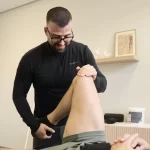
At Fysio Fitaal, we don't believe in ‘waiting for it to pass’. We address the cause. During the intake, we listen to your story and perform a comprehensive physical examination.
We often put ultrasound in to see exactly what is going on. An ultrasound allows us to visualise the tendons, bursas and ligaments. For example, we can directly detect inflammation of the patellar tendon or fluid in the joint. This helps us draw up a specific treatment plan.
Our treatment focuses on three pillars:
- Pain relief: Through counselling, mobilisations or dry needling if needed.
- Increasing capacity: With targeted exercises, we strengthen the quadriceps (thigh muscles), hamstrings and glutes.
Optimising movement: We look at your running technique and the position of your feet to prevent recurrence.
Get rid of your knee problems
Don't keep walking with an overused knee. The longer you wait, the longer recovery often takes. At Fysio Fitaal (Reeshof, West and other locations), we are ready to help you. With our modern facilities and expertise in sports physiotherapy, we will make sure you can move strong and pain-free again.
How long does recovery take?
The overloaded knee recovery time varies from person to person and depends on how long you have been walking around with the symptoms. Tendon tissue has a slow metabolism and thus needs time to recover. Below is an overall timeline of a rehabilitation process.
| Phase | Period | Focus |
| Phase 1: Rest & Reduction | Week 1-3 | Reduce pain, reduce swelling, alternative exercise (cycling). |
| Phase 2: Build up Load capacity | Week 3-8 | Strength exercises for hip and knee, stability training. |
| Phase 3: Specific Training | Week 8-12+ | Building up to running sports, jumping power and explosiveness. |
Frequently asked questions
How do you know if your knee is overloaded?
You will recognise this by a combination of symptoms: pain that increases on strain, starting stiffness in the morning, and sometimes slight swelling. Unlike acute pain (as in a twist), these symptoms creep in slowly.
Can I keep walking with an overused knee?
Yes, exercise is actually good to stimulate blood flow and reduce stiffness. However, do not walk to the point where pain increases substantially. If you experience an increase in pain (rating >4 on a scale of 10) during or after walking, you should shorten the distance or pace.
How is it different from osteoarthritis?
Osteoarthritis involves wear and tear of the cartilage, often causing permanent stiffness and pain. Overuse often involves the soft tissues (tendons/muscles) and is, in principle, fully recoverable. Symptoms such as onset stiffness can be similar, though. A physiotherapist can distinguish between them.
Does a brace or tape help with overuse?
A brace or medical tape can support the knee and relieve pain temporarily. This can be pleasant to sustain daily activities. However, it is not a structural solution; strengthening the muscles is necessary for long-term recovery.
When should I see the physiotherapist?
If the pain does not subside after two weeks of relative rest, if your knee becomes swollen or red, or if you are unsure about the cause, it is wise to make an appointment. At Fysio Fitaal, we can use ultrasound to quickly determine if there is damage.
Related exercises


Related complaints

Patellofemoral pain syndrome (PFPS)
Patellafemoral pain syndrome is an umbrella term for several complaints at the front of the knee
Osgood Schlatter
In active children and teenagers, this may be accompanied by specific physical complaints. Do you have...
Creaking knees (Crepitus)
You walk up the stairs and at every step you hear it: snap, snap, snap....
Make an appointment at Fysio Fitaal
We work from multiple locations in Tilburg, always close by for professional and accessible physiotherapy. Fill in the contact form and we will contact you soon. Together, we will work on your recovery!