 Nederlands
Ruben Luijkx, Master of Science and co-owner of Fysio Fitaal, specialises in sports-related complaints, ultrasound diagnostics and manual therapy. Writing on physiofitaal.nl, he introduces you to the expertise and professionalism of Fysio Fitaal in Tilburg.
Seated good morning
The seated good morning is a hip and trunk exercise that involves controlled forward bending from the hips while sitting, while the back remains in a neutral position. Because the exercise is performed in a seated position, the contribution of the legs is minimised and there is a stronger emphasis on trunk tension and hip mobility.
This variation is particularly suitable for training hip hip hip awareness and building controlled load on the lower back and posterior chain. It is an effective exercise within both mobility and strength building.
Table of contents

Purpose of the exercise
Focuses on improving hip hinge mechanics, trunk tension and posterior chain mobility. Strengthens hamstrings, low back muscles and glutes in a controlled setting. Supports functional bending and lifting movements.
Supplies
-
Bench or sturdy chair
-
Possibly light dumbbell, dumbbell or stick
-
Flat surface
Starting position
-
Sit upright on a bench
-
Feet firmly on the ground, slightly wider than hip width
-
Knees bent at about 90 degrees
-
If necessary, keep a light weight on the upper back
-
Core tightened
-
Back in neutral position
Implementation
-
Push the hips back slightly
-
Bend forward controlled from the hip
-
Keep the back neutral
-
Move to a comfortable end position
-
Feel tension in hamstrings and low back
-
Return to the starting position in a controlled way
-
Maintain control throughout movement
Points of interest
✓ Movement comes from the hip
✓ Keep back neutral
✓ Core continuously tightened
✓ Move slowly and in a controlled manner
✓ Breathe calmly during movement
✗ Round lower back
✗ Excessive bending forward without control
✗ Using too heavy a weight
✗ Drop knees inwards
✗ Ignoring pain in lower back or hamstrings
When this exercise?
The seated good morning is used to train controlled hip flexion and trunk tension, especially when hip hinge awareness is central. The exercise is suitable within rehabilitation for low back or hamstring injuries, if performed pain-free.
In addition, this exercise can be used as a preparatory step towards standing goodmorning or deadlift variations. The seated position makes the load easy to dose and control. Application, loading and progression should always take place in consultation with a physiotherapist or other qualified professional, to ensure that the exercise is safe and tailored to individual load capacity, symptoms and recovery status.
Table of contents
Related complaints

Hamstring
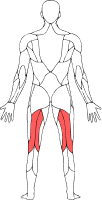
The hamstrings are a group of muscles at the back of your thigh. This muscle group...

Back pain
Back pain is becoming increasingly common. Back pain can occur acutely or gradually increase. The most common...