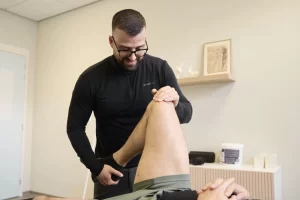
Purpose of the exercise
Focuses on strengthening the glutes and hamstrings. Improves hip extension strength and pelvic stability. Supports a stable torso and correct hip movement patterns.
Supplies
Starting position
-
Lie supine on a mat
-
Place feet hip-width apart on the floor
-
Knees bent
-
Arms along the body
-
Core slightly tightened
-
Pelvis in neutral position
Implementation
-
Actively tighten the glutes
-
Push the hips up in a controlled way
-
Bring the body in a straight line from knees to shoulders
-
Briefly hold tension in the upper position
-
Lower the hips slowly and in a controlled manner
-
Return to start position
Points of interest
✓ Actively tighten the glutes
✓ Keep the pelvis stable
✓ Core slightly tightened
✓ Move controlled
✓ Push up through the heels
✗ Hollowing the lower back
✗ Sinking hips askew
✗ Execution too fast
✗ Drop knees inwards
✗ Ignoring pain in hip or lower back
When this exercise?
The glute bridge is used to improve strength and activation of the glute muscles. The exercise is suitable within strength training and is often used within rehabilitation programmes where hip stability and pelvic control are important.
In addition, the exercise can serve as a preparatory step towards more complex hip exercises such as hip thrusts, lunges or deadlift variations. Through variations in execution, the load can easily be adjusted to the athlete's level. Application, load and progression should always take place in consultation with a physiotherapist or other qualified professional to ensure the exercise is safe and tailored to the individual's load capacity, symptoms and recovery status.
 Nederlands