 Nederlands
Hamstring pain in running: causes, recovery and when to go to physio
You're nicely in your rhythm, the kilometres fly by like it's nothing. And then suddenly you feel that sharp pain in the back of your thigh. In some cases, it might be more subtle, a nagging pain that is there after every workout. Hamstring pain is one of the most common injuries among runners and at the same time one of the most underestimated. Because that pain often disappears for a while after warming up, so you tend to just keep going. Until one day you really can't do it any more.
In this article, you will read how hamstring complaints in running can occur, how to recognise the signs, and what you can do to recover properly and permanently.
What do the hamstrings do during running?
The hamstrings are a muscle group at the back of your thigh, consisting of three muscles: the musculus biceps femoris, the musculus semitendinosus and the musculus semimembranosus. They connect your hip/pelvis to your knee and are responsible for bending the knee and stretching the hip.
During running, they play a crucial role. The moment your leg swings forward and your foot is about to hit the ground, the hamstrings have to slow down the lower leg, so to speak. In doing so, they provide force while simultaneously stretching, this is called eccentric loading, and this is a more complex way a muscle can work.
How does hamstring pain occur in runners?
In runners, most cases involve overuse, not an acute tear. This distinguishes the recreational runner from, say, a sprinter or footballer who ’pulls’ a hamstring during a maximum sprint. For you as a runner, the pain builds up: one workout too many, a week scaled up too quickly in distance or intensity, insufficient recovery between sessions. The muscle, especially the interface between muscle and tendon, becomes irritated and starts to protest. That irritation will initially disappear while running, once you are well warmed up. But if you ignore the signals for too long, the threshold gets lower and lower: the pain comes earlier, stays longer, and at some point it starts to play outside running. Think about climbing stairs, sitting for a long time, or in the morning when getting up.
Certain factors make you extra vulnerable. A previous hamstring injury is perhaps the biggest risk factor. Although the muscle and/or tendon tissue recovers, it remains more susceptible to overuse. Much has been written about the various possible factors that influence this injury. Such as: a lack of eccentric muscle strength, an imbalance with the quadriceps at the front of the leg, limited hip mobility and, above all, practically too little recovery between workouts all play a role. The Achilles tendon wordt bij hardlopen zwaar belast, lees daarom ook hoe je pijn aan je achillespees herkent.
How do you recognise the signs?
Hamstring pain in runners usually presents as a nagging or tight pain at the back of the thigh, sometimes radiating towards the knee or buttock. The pain occurs during or after running, when accelerating, running downhill or after a longer duration. It often disappears at rest, but is sure to return at the next workout.
Loss of strength, sudden sharp pain or visible swelling are rarer in runners. These belong more to acute injuries such as a muscle strain or tear. Still, even a runner can suffer a muscle tear when turning on, especially if the muscle had been overstretched for a long time and the signals ignored.
When pain increases during running instead of staying the same or decreasing, it is a clear sign to stop training. Pain that gets worse under load means that the muscle is currently demanding more than it can handle. Similarly, if the pain disappears during a workout but still increases from workout to workout, it is wise to stand still and give the body some more rest.
Does it still involve an acute tear or a serious injury? Then read our blog: From Munich to Barcelona, another look at muscle injuries - Fysio Fitaal
What can you do yourself?
The good news is that most hamstring injuries in runners get better without sitting still for weeks. Complete rest is rarely necessary and is actually counterproductive for overuse injuries.The tissue needs regular, structured loading to recover properly.
The first step is to scale back intensity. Temporarily stop sprints, hill training and long endurance runs. Replace them with gentle running or another activity such as swimming or walking. That way, you keep moving without further irritating the hamstrings. That's not a step back, that's smart training.
Meanwhile, work on the local load-bearing capacity of the muscle or tendon tissue. Gentle stretching exercises for the hamstrings and hip muscles help reduce pain.
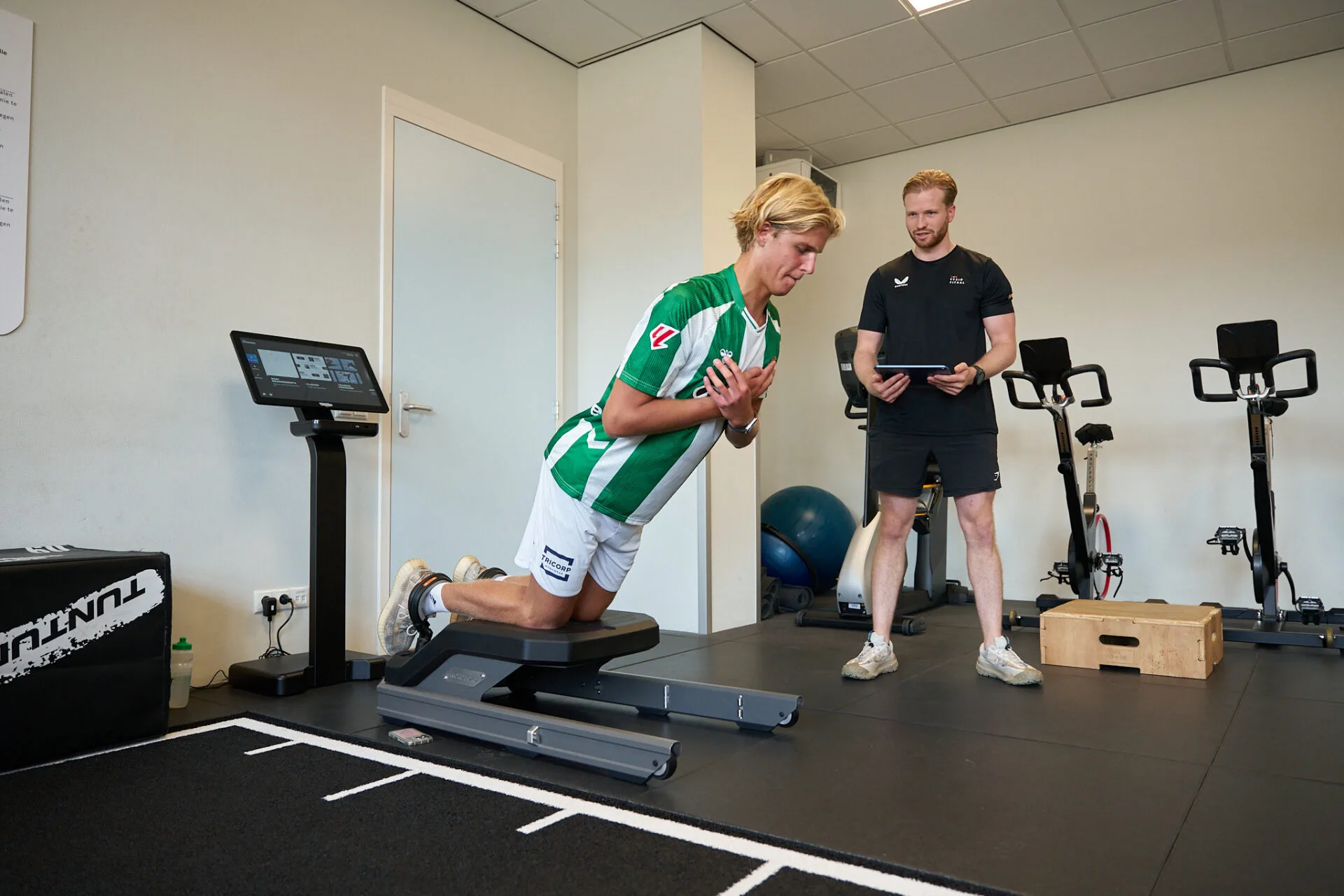
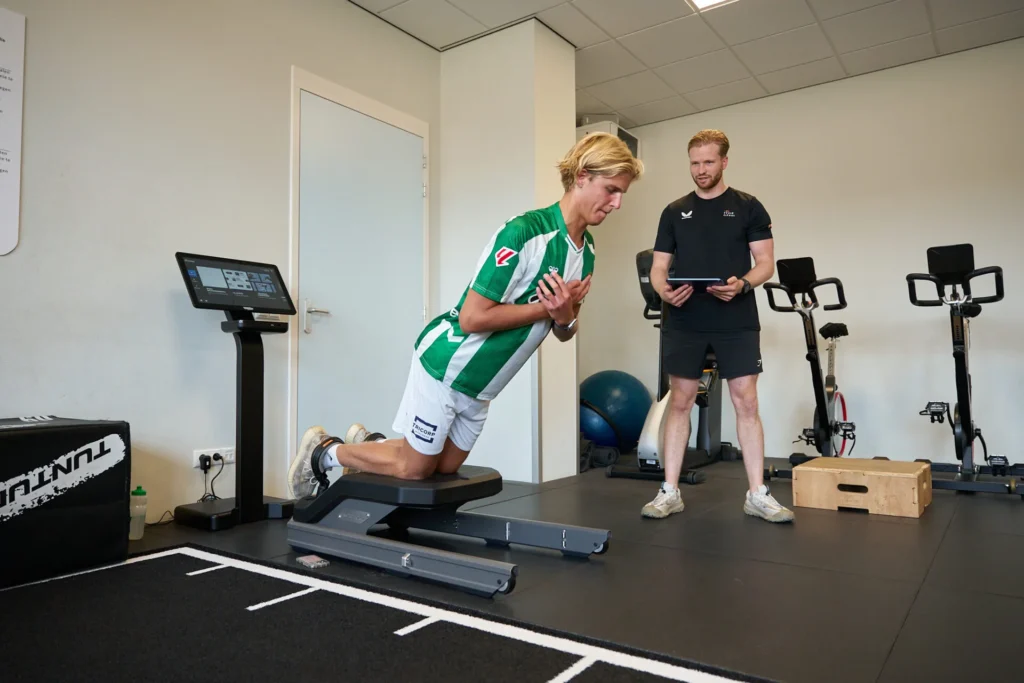
Once there is sufficient mobility and the pain subsides, the most important phase begins: building eccentric muscle strength. Exercises like the Nordic hamstring curl, where you slowly lower your upper body forward from a knee-hanging position, are scientifically proven to be effective in both recovery and prevention of hamstring injuries. Start light, build up slowly and give it time. This is the phase where most runners go wrong: as soon as the pain is gone, they resume their old training schedule. But by then, the tissue is not yet strong enough to handle that load.
When do you go to the physiotherapist?
If the symptoms do not noticeably improve after two to three weeks, keep coming back as soon as you pick up the pace, or if you have doubts that there is more to it than overuse, it is smart to consult a physiotherapist.
That cause is by no means always the hamstring itself. Sometimes the problem is in the training structure, sometimes in a strength deficit elsewhere in the chain, the hip stabilisers, the trunk, the foot settlement. A physiotherapist will look at the whole picture and help you not only recover, but also train smarter.
Ultrasound: when does imaging make sense?
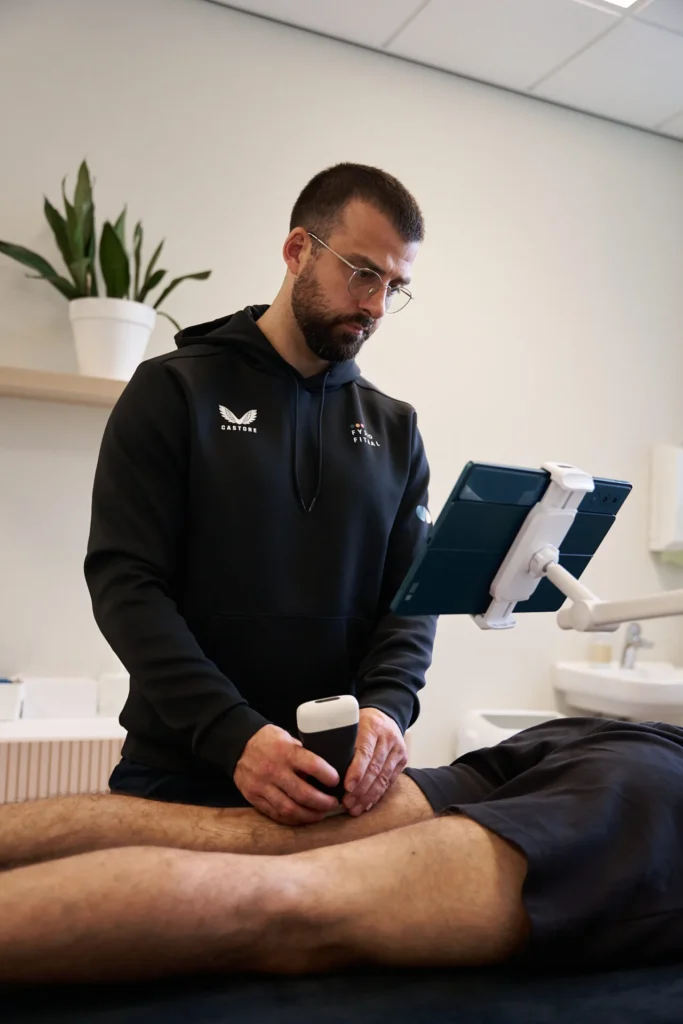
In most runners with hamstring complaints, imaging is not immediately necessary. A good history and physical examination already provide a lot of information. But sometimes there is doubt: is this really overuse, or is there more behind it? At Fysiofitaal Tilburg, we use ultrasound as an additional tool when we want more clarity about the symptoms.
Ultrasound allows us to image the muscle fibres, fascia and musculotendinous transition in real time. This allows us to see whether the symptoms are caused by an irritable transition without structural damage, which is the case in most runners, or whether there is more to it after all. This not only gives certainty, but also helps us set the right expectations about the recovery path.
At Fysiofitaal Tilburg: approach that looks beyond
At Fysiofitaal in Tilburg, we start with a comprehensive analysis. We listen to your story, when the symptoms started, how they behave during and after running, what your training pattern looks like.
Then we look at the contributing factors: what about your eccentric muscle strength? Is there sufficient hip and knee mobility? Is there anything in your running technique that puts unnecessary strain on the hamstrings? Based on all this information, we make a personal plan, not a standard protocol, but an approach that suits your body, your training and your goals.
Because the goal is not just to be pain-free. The goal is being able to run, accelerate and sprint confidently, without having to wait and see how the upper leg reacts after every workout.
Suffering from hamstring pain when running? Make an appointment at Fysiofitaal Tilburg. Together, we will find the cause and guide you back on the track quickly and safely.
Related complaints

Proximal hamstring complaints
Hamstring injuries are common in athletes. Quick action and targeted Physiotherapy can...
Hamstring
The hamstrings are a group of muscles at the back of your thigh. This muscle group...

Achilles tendon problems in runners
Achilles tendon complaints are a common problem in people who are active in sports ...