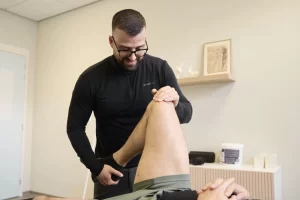
Hip Bridge
Purpose of the exercise
Strength exercise for the glutes (gluteus maximus), hamstrings, lower back (erector spinae) and core. Improves glute activation, hip extension strength and pelvic stability. Also effective for prevention and treatment of low back pain, improving posture and posterior chain development. Helps to “wake up” inactive gluteal muscles due to a lot of sitting.
Supplies
- Mat or soft surface
- Sufficient space to lie outstretched
- Optional: resistance band around knees for extra activation
- Optional: weight disc or barbell on hips for progression
Starting position
- Lie on your back on a mat
- Bend both knees with feet flat on the ground
- Place your feet hip-width apart, about 30 cm from your buttocks
- Place your arms next to your body, palms down
- Keep your head relaxed on the ground
- Keep your pelvis in neutral position
- Slightly tighten your core
Implementation
- Push through your heels to lift up your hips
- Lift your hips off the ground
- Tighten your buttocks to the max at the top
- Lift until your body forms a straight line (shoulders hip knees)
- Keep your knees above your ankles (not inwards or outwards)
- Hold this position for 1-2 seconds
- Squeeze your buttocks together at the top
- Release controlled back to the ground
- Repeat the movement
Points of interest
- ✓ Push through your heels (not your toes)
- ✓ Tighten your buttocks to the max at the top
- ✓ Keep your knees in line with your feet
- ✓ Make a straight line (shoulders-hips-knee)
- ✓ Keep your core tense
- ✓ Exhale when pushing up, inhale when lowering
- ✗ Avoid lifting too high (hyperextension lower back)
- ✗ Don't use too much lower back (focus on buttocks)
- ✗ Don't let your knees fall inwards
- ✗ Don't push through your toes
- ✗ Don't lift halfway up - make full movement
- ✗ Don't let your hips sag to one side
When this exercise?
This exercise is suitable for anyone who wants to develop gluteal strength or activate glutes. Ideal as a warm-up exercise for leg training or as an activation exercise after sitting for a long time. Very effective in rehabilitation for low back pain, hip pain or hamstring injuries (in consultation with physiotherapist). Perfect as a basic gluteal exercise for beginners. Also valuable for people with “dormant” glutes due to a lot of sedentary work. Suitable as a daily activation exercise. Can be performed several times a day. In case of acute back or hip pain, have it assessed by a physiotherapist first. Start with bodyweight and focus on maximum gluteal contraction at the top before adding weight.
 Nederlands