 Nederlands
Good morning
The Good Morning is a hip-hinge exercise in which you move the hips backwards in a controlled manner from a standing position while the torso tilts forward. The exercise emphasises controlled loading of the posterior chain (posterior chain) and requires good trunk stability and movement control. The movement is very similar to the hip hinge that occurs in lifting, sprinting and braking.

Purpose of the exercise
Focuses on strengthening the hamstrings, glutes and erector spinae, with active involvement of the core. Improves hip hip mechanics, eccentric control and posterior chain strength. Supports injury prevention and strength transfer in athletic and functional movements.
Supplies
-
Barbell, safety bar or light resistance
-
Flat and stable surface
-
Possible rack for safe placement of the bar
Starting position
-
Place the bar on the upper back (similar to squat position)
-
Stand upright with feet at hip to shoulder width
-
Knees slightly bent
-
Core tightened and chest slightly raised
-
Gaze forward or slightly downward
Implementation
-
Push the hips back in a controlled way
-
Let the torso tilt forward from the hips
-
Keep the spine neutral
-
Sink until tension is felt in hamstrings
-
Maintain slight knee flexion
-
Brake downward movement in a controlled manner
-
Push the hips forward again
-
Return to the starting position in a controlled way
Points of interest
✓ Movement comes from the hips, not the lower back
✓ Keep spine neutral
✓ Core actively tightened
✓ Weight evenly distributed on both feet
✓ Move in a controlled and conscious manner
✗ Round or concave back making
✗ Too deep forward bend without control
✗ Excessive bending of the knees (loss of hinge pattern)
✗ Using too heavy a weight
✗ Ignoring pain in lower back or hamstrings
When this exercise?
Good Morning is used in strength training, sport-specific programmes and rehabilitation to strengthen the posterior chain and improve hip-hinge mechanics. The exercise is relevant for athletes who need strength and control during sprinting, braking, lifting and directional changes. In addition, Good Morning can be used as a supporting exercise to improve deadlift and squat technique.
Because of the load on the lower back and hamstrings, this exercise requires good movement control and strength base. In rehabilitation or build-up programmes, the exercise should be introduced carefully. Application, loading and progression should always take place in consultation with a physiotherapist or other qualified professional, so that the performance is safe and tailored to individual load capacity, symptoms and recovery status.
Related complaints

Ankle complaints
When spraining the ankle, you often tear or strain one or more ankle ligaments....

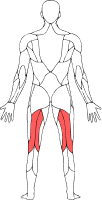
Hamstring
The hamstrings are a group of muscles at the back of your thigh. This muscle group...

Knee complaints
Especially with knee problems, it is imperative to get a good picture of the...