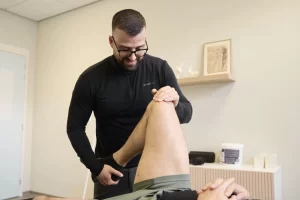
Purpose of the exercise
Aims to strengthen deep and superficial neck flexors and improve active neck control in flexion direction. Supports postural control of head and neck and contributes to load capacity in daily activities and sports. Relevant in complaints related to prolonged posture, such as head bent forward.
Supplies
Starting position
-
Lie supine on the sofa
-
Position the body stably on the bench
-
Let the head hang relaxed over the edge
-
Arms rest relaxed along the body or on the bench
-
Shoulders relaxed
-
Neck in neutral starting position
Implementation
-
Start with head facing slightly backwards
-
Raise the head in a controlled manner
-
Bend the neck to a neutral or slight flexion position
-
Move without momentum or jerks
-
Maintain control over the entire movement
-
Lower the head slowly and in a controlled manner
-
Maintain relaxation in shoulders and upper back
Points of interest
✓ Move calmly and in a controlled manner
✓ Keep shoulders relaxed
✓ Move within a pain-free range
✓ Focus on control, not speed
✓ Breathe calmly during the movement
✗ Excessive bending of the neck
✗ Jerky movements
✗ Tension in shoulders or upper back
✗ Execution too fast
✗ Ignoring pain in neck or head
When this exercise?
Flexion neck with head over bench is used to improve neck flexor strength and control, for example in posture-related neck pain or reduced active neck control. The exercise can be part of rehabilitation and preventive training to gradually build up the load capacity of the neck.
As the exercise uses gravity as resistance, accurate and calm execution is essential. The exercise is less suitable for acute neck pain, dizziness or neurological symptoms. Application and progression should always take place in consultation with a physiotherapist or other qualified professional to ensure that the exercise is safe and tailored to individual load capacity, symptoms and recovery status.
 Nederlands