Nederlands
What helps with neck pain
Many people are familiar with neck pain. Sometimes neck pain develops gradually after a busy week at work, but sometimes you wake up in the morning with a stiff neck for no apparent reason. When the pain strikes suddenly with a particular movement, we call this acute neck pain. However it starts, neck pain often occurs just when you want to carry on as normal. It can significantly disrupt your daily life: working at a computer screen is difficult, as is looking behind you in the car, exercising or lifting a bag. Even sleeping can be difficult, especially when, for example, you’re trying to turn over in bed.
The good news is that most neck problems ease over time. For a smaller group of people, however, the pain persists for longer or keeps coming back. And that’s when the question of what helps with neck pain quickly becomes a pressing one. It’s a logical question, but the honest answer isn’t always straightforward. It depends on the cause, how long the problem has lasted and your daily routine.

The first few days with neck pain. What helps?
When you have acute neck pain, there is a strong tendency to move your neck as little as possible. This feels safe, but complete rest is not advisable in almost all cases. In most cases, it helps to keep moving gently within the limits of your pain. Movement itself, when done sensibly, has a natural pain-relieving effect. Think of things like walking normally, letting your shoulders hang loosely and moving your neck occasionally to the left and right without forcing it. The aim is not to push through the symptoms, but to prevent stiffness from taking over. Heat can be soothing – for example, a warm shower or a hot water bottle – but this varies greatly from person to person and is certainly not essential.
Pain relief can be helpful. It is primarily intended to make movement possible again. The main aim, therefore, is to help you get moving again. If you do not need it, try managing without it. It is best not to take medication regularly on your own initiative, but to follow the instructions in the patient information leaflet or consult your GP or physiotherapist.
There are various causes of neck pain
Many people immediately think of poor posture. That can certainly be a cause, but neck pain is rarely caused by a single factor. Much more often, it is the result of a combination of factors: sitting in the same position for long periods, a lack of variety, stress, poor sleep, a temporary reduction in physical resilience, or sudden overexertion during sport or work.
For this reason, a quick fix doesn’t always work. A new pillow, an ergonomic chair or a massage can help, but is often just one piece of a bigger puzzle. If your stiffness is mainly caused by spending hours working at a computer screen, then variety and targeted exercise therapy are often more effective than passive treatment alone. If you have neck pain following a fall or an accident, this requires a different approach, and it’s particularly important to respect your limits and take it easy for a while.
The perfect posture for neck pain
A comfortable working posture is nice, but it’s not set in stone. Your body is designed to move, not to sit still for hours on end. If you constantly try to sit perfectly upright, you’ll end up with discomfort in certain parts or structures of your neck or lower back. There’s no such thing as ‘bad posture’, only a lack of variety.
So what works better is to change your posture regularly. Sit in a slightly more active position for a while, then lean back slightly; stand up every now and then, walk around for a bit, and alternate between typing, making calls and reading. This variety reduces the static strain on the same muscles and joints.
Exercises to help with neck pain
Exercises for neck pain can be an effective way of alleviating symptoms. Not because every symptom disappears like snow in the sun with just a few standard exercises, but because targeted movement supports recovery. This involves control, mobility and a gradual build-up of strength.
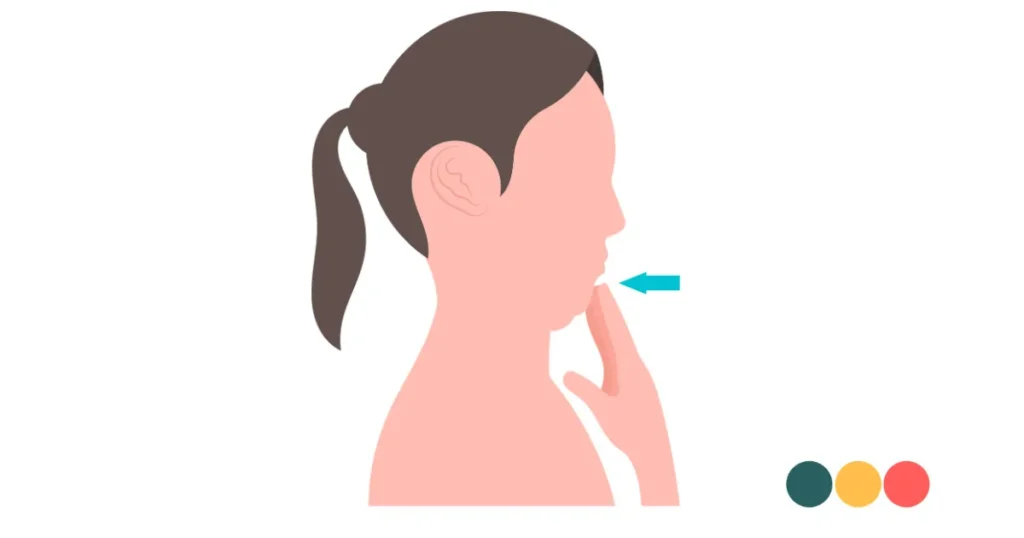
A simple way to start is to gently tuck your chin in, as if you were creating a double chin, without tilting your head. Gently turning your head to the side and moving your shoulder blades downwards also helps to alleviate the symptoms. There’s no point in forcing it. A slight stretch or tiredness is fine, but sharp or increasing pain certainly isn’t. Exercises shouldn’t irritate your neck further, but rather help you regain confidence in moving it.
The effect of a good night’s sleep on the pain system
Sleep plays a bigger role than many people realise. A restless night’s sleep often makes pain symptoms worse, and that’s no coincidence. This isn’t just the case with neck pain; it’s often noticed in people with other conditions as well. Sleep deprivation makes your nervous system more sensitive, causing pain signals to be transmitted more intensely and lowering your threshold for perceiving something as painful.
Normally, sleep enables the body to repair tissue and regulate inflammatory processes. If you sleep too little or your sleep is too restless, this recovery process is hindered and symptoms may persist for longer than is desirable.
In cases of truly long-term sleep deprivation, this relationship becomes even clearer. We see that poor sleep and chronic pain reinforce each other. Persistent pain disrupts sleep, and disrupted sleep makes the pain system even more sensitive. Research even shows that poor sleep is not only a consequence of pain, but can also be a predictor of the onset and persistence of pain symptoms. Sleep is therefore a key factor in determining how quickly or slowly a condition recovers.
An expensive, specialised pillow is certainly not the solution here. What matters more is whether you get enough sleep and whether that sleep is of good quality. A good night’s sleep gives your body the best chance to recover properly. Apart from the need to lie comfortably, the exact type of pillow or mattress is far less important than is commonly thought.
Manual therapy and neck pain
In addition to exercises and advice on how to exercise are also available manual therapy a valuable role exercising if you have neck pain. Think of cautious mobilisations, where a joint calmly and repeatedly be inside natural the trajectory becomes moved, or to techniques that the surrounding muscles help you relax. The aim is to easier to move and less to make it painful, so that afterwards you can get better again build up.
Broadly speaking, two types of technique are used. Mobilisation involves gently and repeatedly moving a joint within its natural range of motion, at a gentle pace and with careful control. Manipulations involve a short, rapid and precise movement at the end of the range of motion, often accompanied by an audible “click” or “crack”. This click is harmless and is caused by a change in pressure within the joint, not by anything “snapping into place”. In addition, techniques are often used to help relax the surrounding muscles. The aim of all these techniques is the same: to make movement easier and less painful, so that you can gradually build up your activity levels again afterwards.
Manual therapy is effective on various levels
Research shows that manual therapy can be effective in various ways:
Peripheral (local level). Manual therapy affects processes involving the nerve endings and connective tissue in the affected area. This occurs, amongst other things, through changes in the sensitivity of pain receptors. In simple terms: the tissue in the affected area becomes temporarily less sensitive, making movement easier.
Segmental-spinal (at the level of the spinal cord). The treatment affects the way in which pain signals are transmitted through the spinal cord and filtered before they reach the brain. In simple terms: the pain signals from the spinal cord are, as it were, less intense, making the area less sensitive.
Supraspinal (in the brain). Manual therapy activates natural pain-relieving systems in the brain and brainstem. From there, nerve pathways run which can actively suppress pain signals, including via neurotransmitters such as serotonin and noradrenaline. In simple terms: a natural pain-relieving system becomes more active, causing the pain to be perceived (temporarily) as less intense.
Be sceptical of anyone who claims that your neck needs to be “straightened”. Our bodies are not cars that need to be ‘aligned’; a vertebra does not pop out of place and does not need to be put back in. The audible ‘click’ during a manipulation is not proof that anything has been ‘put back in place’, but simply a change in pressure within the joint. Manual therapy does not work because something shifts, but through the mechanisms described above.
What’s more, the problem with “correcting” is that it makes you dependent on a particular treatment. If you truly believe that you need to be corrected time and time again, you’ll keep coming back for the same treatment without your neck becoming any more resilient. At Fysio Fitaal, we consciously choose the opposite approach. Manual therapy can get your movement going again, but the aim is for you to be able to carry on under your own steam.
Source: Unravelling the Mechanisms of Manual Therapy: Modelling an Approach
Sustainable recovery requires a plan
If you want to get rid of neck pain, a structured approach and a plan will be more helpful than a few isolated pieces of advice. First, we need to establish exactly what the problem is and what is perpetuating the symptoms. Then we’ll look at what you need: greater mobility, reduced muscle tension, improved resilience, or perhaps simply more confidence in moving normally.
The difference also lies between simply experiencing a little less pain and making a genuine recovery. Lasting results come when you understand why the symptoms keep returning and know what you can do yourself to break this pattern. Sometimes the benefits come from small adjustments throughout the day, sometimes from a targeted set of exercises, and sometimes from a combination of treatment and gradual progression.
So neck pain doesn’t have to be something you simply put up with. With the right perspective and an approach that fits in with your daily life, work and sport, you can often make progress faster than you think. The first step is usually not to try harder, but to take a smarter look at what your neck really needs right now.
Frequently asked questions about neck pain
How long does neck pain usually last?
With acute neck pain, the first few days are often the most painful, after which the pain gradually subsides. For most people, moving around becomes much easier again within one to two weeks. If the pain persists for longer or keeps coming back, it is advisable to seek a specialist assessment.
Can I carry on exercising or playing sport if I have neck pain?
Yes, in most cases, continuing to move gently is actually beneficial. Moving within your pain threshold supports recovery, whilst complete rest often prolongs stiffness and tenderness. Above all, avoid movements that cause sharp or radiating pain, and build up the intensity gradually.
Is my neck pain caused by poor posture?
Posture can sometimes be a factor, but it is rarely the sole cause. More often than not, it is the result of sitting in the same position for long periods, a lack of variety, stress, poor sleep and a temporary reduction in physical resilience. Changing your posture and introducing variety therefore usually helps more than trying too hard to sit “perfectly” upright.
Does a new pillow or mattress help with neck pain?
An expensive, specialised pillow is rarely the solution. What’s more important is that you get enough good-quality sleep and lie comfortably without constantly waking up because of stiffness. Sleep has a significant impact on your sensitivity to pain and your recovery.
When should I see a doctor or physiotherapist if I have neck pain?
Have it assessed if the pain does not subside after a few days, recurs regularly, or interferes with your work, sport or sleep. Take action sooner if you have neck pain following an accident or a hard fall, or if the pain radiates to your arm or hand, or if you experience loss of strength, tingling, severe headaches, dizziness or a fever.
Related complaints

Cervical radiculopathy neck pain (with radiation)
In a cervical radiculopathy, there is pressure on a nerve root in the neck