Nederlands
Anterior cruciate ligament rehabilitation without surgery
A complete torn anterior cruciate ligament is a hard limit for many people. The knee feels unreliable, turning gives uncertainty and sport suddenly seems far away. Yet it is not always chosen to at least immediately repair the anterior cruciate ligament through surgery. And it certainly can be done, but you really have to go for a transparently constructed course, clear measuring points and, above all, honest expectations.
Not every anterior cruciate ligament injury requires immediate reconstruction(repair of). This is perhaps the most important starting point. Recent scientific literature shows that conservative treatment in a smaller group of patients can give the same outcomes as after surgical intervention. With side note the rehabilitation protocols used for this purpose are still highly variable among themselves, and this affects outcomes.
When is rehabilitation without surgery a good option?
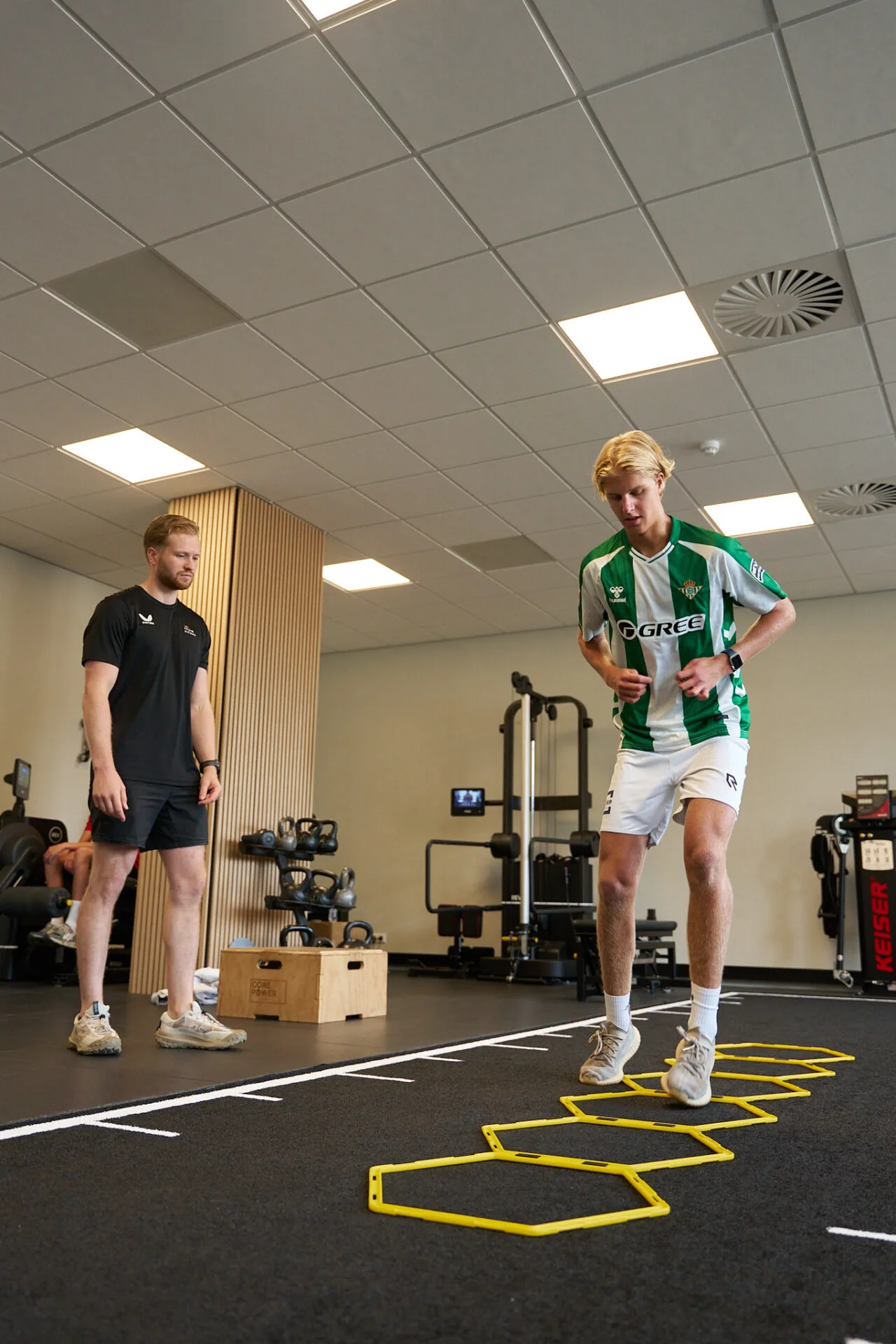
Conservative treatment fits best in people who do not engage in any rotationally strenuous contact sports, in whom the knee feels reasonably stable in daily life. There is also no obvious lock symptoms or significant collateral damage. Think of someone who simply wants to walk, cycle, work out or move recreationally without quick cap and turn movements. Especially recreational exercise is, of course, a very broad term.
At the same time, there are situations where you are less likely to get away without surgery. Lots of giving way moments, a strong desire to return to football, handball or skiing. Also secondary injuries to meniscus or cartilage make the trade-off a lot more difficult. Scientific research also shows this, in cases of damage along with the meniscus or possibly other ligament damage such as medial or lateral ligament, reconstruction is more often recommended to reduce the risk of further structural damage.
A younger age is often a reason to do surgery when possible. Not because conservative treatment cannot be successful, but because of what can happen in the longer term if the knee remains unstable. In other words, the risk of meniscus or cartilage damage is not desirable and can lead to major problems at a relatively young age. Every moment of instability is a risk of new damage in the knee joint.
In this sense, surgery in younger patients is therefore more of a preventive measure. Surgery is not performed because conservative treatment would not be possible, but because the biological and mechanical risks of a long-term unstable knee in someone who still has decades of active years ahead of him outweigh the risks of reconstruction.
What does research say about the outcomes of conservative treatment?
Here's where things get a little technical. A recent review of Ghezzi et al. (2026) analysed 14 studies with a total of 570 athletes treated conservatively after anterior cruciate ligament rupture.
Of these 570 athletes, 53%, about 300 athletes, completed rehabilitation without undergoing surgery. The remaining 47% still opted for surgery during the rehabilitation process.
Of the 300 athletes who fully completed conservative rehabilitation, 169 eventually returned to sport. That is 30% out of the original group of 570.
Of those 169 athletes who returned to sport, 28% suffered recurrence(i.e. another knee injury due to instability). Incidentally, a quarter of them still opted for delayed surgery.
In analysing these figures, honesty is in order. “Return to sport” was defined very broadly in most studies. This was return at any level, not necessarily the pre-injury level. Thus, the actual return to the prior performance level is in all likelihood even lower. In addition, the average rehabilitation duration was only 12 weeks, a period that we but also the authors themselves considered insufficient for adequate rehabilitation.
What is the purpose of rehabilitation without surgery?
The goal of conservative treatment should be functional recovery. Logically, the goal should not be to recover from the torn cruciate ligament. Functional recovery can be defined as: controlling swelling, regaining mobility, building muscle strength, improving neuromuscular control and making the knee loadable enough to allow safe movement again.
This involves more than just the upper leg muscles. A knee never functions in isolation from everything else. Forces around the hip, trunk and ankle joint along with the timing of movement all affect how stable the knee feels.
Looking at the content of conservative rehabilitation programmes, it is notable that strength exercises in particular dominate with 48% of the total. Followed by sports-specific training at 25%. Neuromuscular control and jump training are significantly underrepresented with 10% and 4%.
Neuromuscular training is not the same as sports-specific training
Both forms of training are essential during rehabilitation, but they actually train something different. Neuromuscular training involves retuning the nervous system, as it were. With a torn anterior cruciate ligament, not only is a connection damaged, there are mechanoreceptors in the cruciate ligament that continuously transmit information to the brain about the knee's position, movement and tension. After a rupture, some of that sensory feedback falls away. The brain therefore controls the knee less efficiently, leading to slower or different muscle activation. Neuromuscular training focuses on restoring that control: balance, coordination, dual tasking and responding to external stimuli ensure that the knee is once again and reliably controlled. Sports-specific training then builds on that. It focuses on the demands of your sport: sprinting, braking, turning and jumping with the speed and unpredictability that comes with it.
Equally important is confidence. Many people with cruciate ligament injuries move differently: they brake differently, avoid rotation and move less fluidly. Understandable, but not desirable. Good rehabilitation helps not only getting stronger, but also daring to move normally again. How prepared someone is psychologically to return to sport is therefore a well-researched prognostic factor. Athletes with higher scores on the ACL RSI scale have a lower chance of a new injury (recurrence) and have better functional outcomes.
What does a conservative trajectory entail?
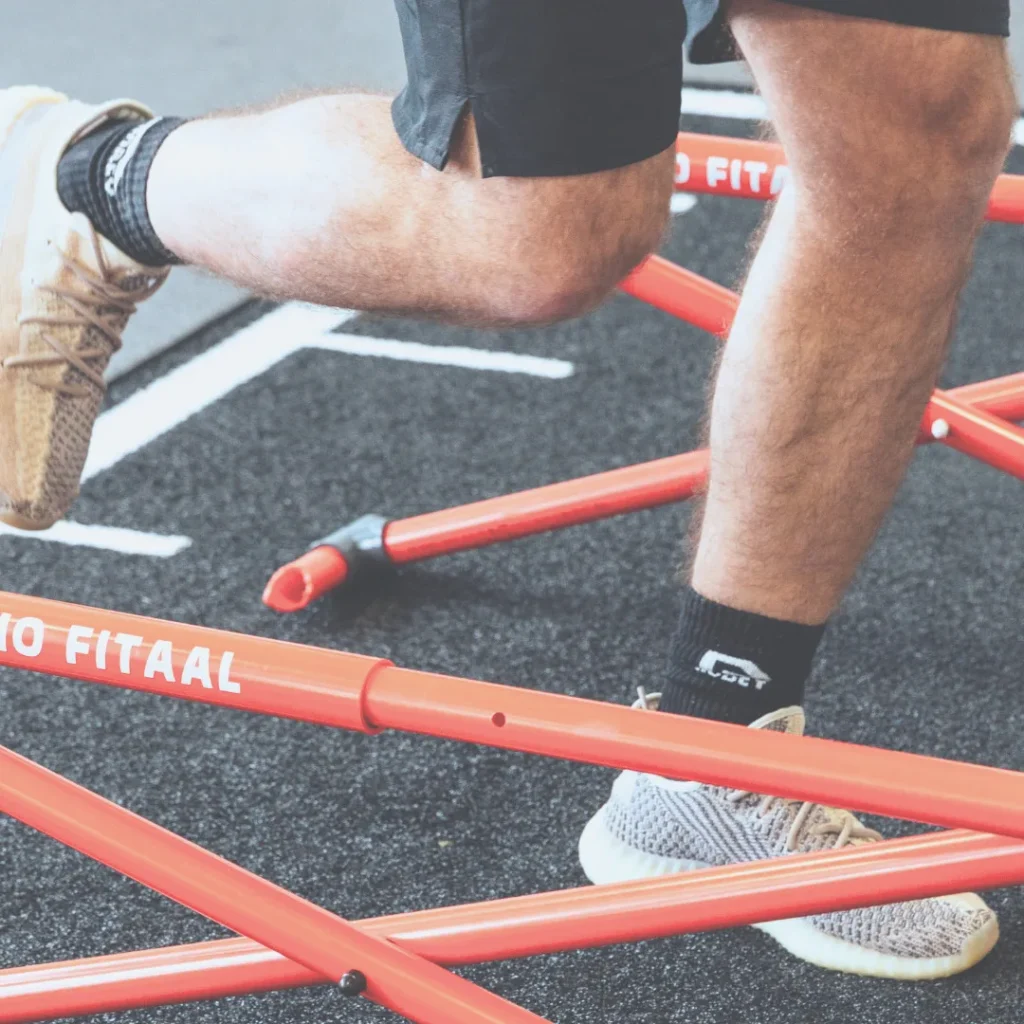
In the first weeks, the focus is on soothing the knee. Swelling, pain and restriction of movement can significantly interfere with muscle function. Full recovery of extension(stretching of the knee) is an absolute priority here. When stretching lags, it affects gait, strength building and the ability to load the knee correctly.
During rehabilitation, building strength is one of the most recognisable parts. You normally go through several stages here, from initial muscle mass recovery to explosive strength training. A commonly used measure here is the Limb Symmetry Index (LSI), where we compare the strength of the affected leg to the non-injured leg.
A limit of 10% difference (an LSI of 90%) is often used as a criterion for a safe return to sport. However, this is not the end goal but a minimum requirement. Focusing only on brute strength (muscle mass) is often insufficient, as sports performance and injury prevention depend on how fast that strength can be delivered in fractions of a second. When an athlete has the necessary strength but not the right reaction time and coordination to deal with external forces, the risk of a new injury remains quite high.
Can you play sports again without anterior cruciate ligament surgery?
Yes, you certainly can but not every sport and not for everyone at the same level. Cycling, strength training, running in a straight line and recreational exercise are often quite feasible. In sports with a lot of pivoting, turning and contact, this is already a lot more difficult.
The right question is not: is it technically possible? The better question is: does it suit your knee, your sport and your acceptance of risk? Surely someone who wants to run and accelerate at a high pace three times a week is asking something different of their knee than someone who wants to walk and train pain-free.
25% of all athletes still chose reconstruction even if they had returned to sport. This shows that a decision for a conservative course need not be final. Good rehabilitation is always valuable; even if you still choose surgery later, you will go into surgery stronger and better prepared
No guarantees, but possible
Choosing a rehabilitation path without surgery is a conscious and challenging choice. It is a process that requires patience, discipline and a critical eye for progress. The figures show that success is certainly possible, but the path varies for everyone. You may still come to the conclusion that reconstruction is the wisest step for your sporting ambitions. But it could also be that you achieve your personal goals with a strong and trained knee. Do always opt for a transparent course with frequent measuring moments and remain critical of your functional outcomes.