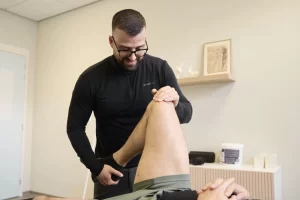
Heel Slide
Purpose of the exercise
Mobility and activation exercise for the knee joint, quadriceps and hamstrings. Improves knee flexion range of motion, activates leg muscles after immobilisation and helps gradually restore normal knee movement. Also effective for reducing stiffness, stimulating joint fluid circulation and preventing adhesions (adhesions) in the knee.
Supplies
- Mat or soft surface
- Smooth surface (makes sliding easier)
- Sufficient space to lie outstretched
- Optional: smooth socks or plastic bag under heel for smoother gliding
- Optional: towel or strap around foot for assistance
Starting position
- Lie on your back on a mat
- Fully extend both legs
- Let your arms relax next to your body
- Keep your head relaxed on the ground
- Keep your pelvis neutral on the ground
- Relax your shoulders
- Keep your foot flat on the ground (or use tool for sliding)
Implementation
- Slowly slide your heel across the ground to your buttock
- Bend your knee as far as comfortably possible
- Keep your foot flat on the ground while sliding
- Stay within your pain threshold (should feel pleasant)
- Hold briefly in the maximally flexed position
- Slowly slide your heel back
- Fully extend your leg
- Repeat the movement
Points of interest
- ✓ Move slowly and in a controlled manner
- ✓ Keep your foot flat on the ground
- ✓ Stay within your comfort zone (no pain)
- ✓ Keep your pelvis stable on the ground
- ✓ Breathe calmly during sliding
- ✓ Try to bend a little further every day (progression)
- ✗ Avoid fast or jerky movements
- ✗ Don't force through pain
- ✗ Don't lift your pelvis off the ground
- ✗ Don't let your foot off the ground
- ✗ Do not use help from your hands (unless prescribed)
- ✗ Don't jump ahead in range - build up gradually
When this exercise?
This exercise is suitable in very early rehabilitation after knee surgery (day 1-2 post-operatively for cruciate ligament, meniscus, total knee replacement) to gradually restore knee flexion (in consultation with physiotherapist). Ideal as first active mobilisation exercise when knee flexion is still very limited. Very effective for preventing stiffness and arthrofibrosis in first weeks after surgery. Perfect as daily exercise, often prescribed several times a day (5-10x per hour during waking hours). Also valuable after prolonged knee immobilisation. Suitable for all ages. Can be combined with Artromot (CPM machine). In case of acute swelling blocking movement, severe pain or if prescribed range is not achieved, consult physiotherapist first. Start gently and celebrate small improvements in range - patience is essential.
 Nederlands