Push-Up
Purpose of the exercise
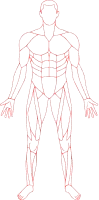
Strength exercise for chest muscles (pectoralis major), anterior shoulders (anterior deltoid), triceps and core stabilisers. Improves relative strength (power to body weight), functional compressive strength and core stability. Also effective for developing shoulder blade stability (serratus anterior) and general upper body strength without equipment.
Supplies
- Flat, stable surface
- Sufficient space to lie outstretched
- Optional: mat for comfort (not too thick because of stability)
- No further material required
Starting position
- Start on hands and knees on the ground
- Place your hands slightly wider than shoulder-width apart on the floor
- Fingers pointing forward or slightly outwards
- Stretch your legs and get into high plank position
- Feet at hip width or slightly narrower
- Keep your body in a straight line from head to heels
- Tighten your core to the max
- Shoulders above or just in front of your hands
- Gaze to the ground (neck neutral)
Implementation
- Bend your elbows and lower your body in a controlled manner
- Keep your elbows at 45 degrees to your body (not fully to the side)
- Descend until your chest almost touches the ground (5-10 cm distance)
- Keep your body in a straight line (no hanging hips or buttocks up)
- Push explosively back up through your hands
- Fully extend your arms
- Maintain tension in your core throughout movement
- Come back to the starting position
Points of interest
- ✓ Keep your body in a perfectly straight line (plank position)
- ✓ Constantly tighten your core (no sagging)
- ✓ Descend in a controlled manner (2-3 seconds)
- ✓ Keep your elbows relatively close to your body (not completely to the side)
- ✓ Make full range of motion (chest almost to ground)
- ✓ Breathe in when lowering, out when pushing up
- ✗ Avoid sagging your hips (core weakness)
- ✗ Don't let your buttocks stick up (spikes)
- ✗ Don't come halfway up - full arm extension
- ✗ Don't let your elbows point fully to the side (shoulder stress)
- ✗ Don't move your head (keep neck neutral)
- ✗ Don't let your shoulders pull at your ears
When this exercise?
This exercise is suitable for athletes of all levels who want to develop upper body strength without equipment. Ideal as a main chest/pressure exercise for home training or as a warm-up exercise for upper body training in the gym. Highly effective for military fitness, functional training, CrossFit and general fitness. Perfect as a benchmark to measure progress in relative strength. Also valuable as an accessory exercise for extra chest volume after bench press. Can be used in rehabilitation after shoulder injuries to gradually build up compressive strength (in consultation with physiotherapist - start with knee or incline version). Suitable for circuit training, HIIT workouts and as part of bodyweight routines. In case of wrist pain, shoulder pain or lower back pain, have it assessed by a physiotherapist first. Start with modified variation (knee or incline) if full push-up is too heavy and build up gradually. Focus on perfect form over number of repetitions - quality over quantity.
 Nederlands