Flexion Low Back
Purpose of the exercise
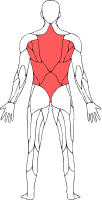
Mobility and stretching exercise for the low back (erector spinae, multifidus), facet joints and lower back fascia. Improves lumbar flexion mobility, reduces tension in the lower back and helps relieve stiffness. Also effective for creating space between lumbar vertebrae and for relief in certain types of back pain where extension (bending backwards) is painful.
Supplies
- Mat or soft surface (for reclining version)
- Chair (for seated version) or sufficient space to stand
- No further material required
Starting position
Supine variant (most commonly used):
- Lie on your back on a mat
- Extend both legs or place feet flat on the ground
- Let your arms relax next to your body
- Keep your head relaxed on the ground
- Relax your lower back
Standing variant:
- Stand upright with feet hip-width apart
- Let your arms hang relaxed
- Knees slightly bent
Implementation
Supine variant:
- Bend both knees and lift your feet off the ground
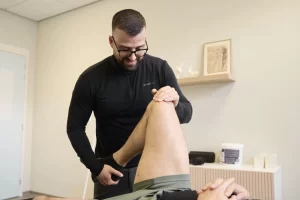
- Grasp your knees or thighs with both hands
- Slowly pull both knees towards your chest
- Have your lower back rounded (flexion of lumbar spine)
- Feel the stretch in your lower back
- Hold this position
- Relax and let your legs return to the ground
Standing variant:
- Slowly bend forward from your lower back
- Let your arms hang down to the ground
- Round your lower back (not forced)
- Feel the stretch in your lower back
- Hold this position
- Slowly come back to upright
Points of interest
- ✓ Move slowly and in a controlled manner
- ✓ Breathe calmly during the stretch
- ✓ Feel a pleasant stretch, no pain
- ✓ Relax your muscles during the stretch
- ✓ Keep the stretch static (no bouncing)
- ✗ Avoid sudden or jerky movements
- ✗ Don't force through pain
- ✗ Do not use this exercise for acute herniated disc or sciatica symptoms without medical advice
- ✗ Don't overstretch (stay within comfort zone)
When this exercise?
This exercise is suitable for people with stiffness in the lower back, especially in complaints that improve with flexion (bending forward). Can be used in rehabilitation for certain back complaints where flexion is advised (in consultation with physiotherapist). Also valuable as a relaxation exercise after activities where the back has been in extension (recline). IMPORTANT: not suitable for everyone - some back problems (such as acute herniated disc with radiation) are actually worsened by flexion. In case of acute back pain, herniated disc, sciatica or unknown back pain ALWAYS have it assessed by a physiotherapist or doctor first. The right exercise depends on your specific condition - what helps for one person may be harmful for another.
 Nederlands