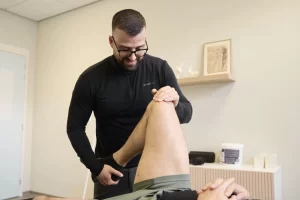
Leg Press Incline Unilateral
Purpose of the exercise
Focuses on strengthening quadriceps, glutes, hamstrings and calf muscles per leg individually, with additional activation of hip and trunk stabilisers. Improves unilateral strength, knee and hip control and functional load capacity. Important for athletes who push off, land or slow down a lot on one leg.
Supplies
Starting position
-
Take a seat in the leg press machine
-
Place one foot centrally on the platform
-
Toes pointed slightly outwards
-
The other leg rests relaxed next to the platform
-
Hips and lower back fully against the railing
-
Core tightened
-
Unlock the platform controlled
Implementation
-
Bend controlled knee and hip of working leg
-
Slowly lower the platform towards you
-
Go to a comfortable and controlled depth
-
Keep the knee in line with the toes
-
Push the platform away via midfoot and heel
-
Stretch hip and knee without locking fully
-
Maintain tension and control during movement
-
Change of leg after completion
Points of interest
✓ Move controlled without jolting
✓ Keep pelvis and trunk stable
✓ Knee stays in line with toes
✓ Pressure through heel and midfoot
✓ Breathe calmly and controlled
✗ Dropping knee inwards
✗ Lower back release from the railing
✗ Sinking too deep without control
✗ Too high resistance without technique retention
✗ Ignoring pain in knee, hip or lower back
When this exercise?
Leg press incline unilateral is used to improve unilateral lower body strength and control. The exercise is very suitable within rehabilitation and build-up programmes for knee, hip or leg injuries, but also as supplementary strength training for athletes who want to reduce left-right differences.
The stable, guided execution makes the exercise easy to dose and safe to apply when free unilateral exercises (such as split squats) are still too taxing. The exercise can be used in different phases of training and recovery, if performed pain-free and controlled. Application, loading and progression should always take place in consultation with a physiotherapist or other qualified professional so that the exercise is tailored to individual load capacity, complaints and recovery status.
 Nederlands