Nederlands
Anterior cruciate ligament rehabilitation phases explained
The first weeks after an anterior cruciate ligament injury or cruciate ligament surgery often feel contradictory. You want to make strides now but your knee sets the pace. This is precisely why it is necessary to divide rehabilitation into clear stages. Not as a simple calendar or timeline on paper, but as a practical guide to return to daily movement, work and sport safely, purposefully and step by step.

Why work with clear phases?
An anterior cruciate ligament rehabilitation rarely goes perfectly. One week it goes better, while the next week the knee gets thick again after a harder workout. That is part of the process. These stages give you some kind of footing, because you are not just looking at time since injury or surgery, but more importantly at what your knee can actually handle.
That difference is significant. Two people can both be six weeks postoperatively, with one already steadily pedalling and the other still struggling to fully stretch. Those who manage by calendar alone take unnecessary risks. Those who steer by function, load capacity and measurable progress work much smarter on recovery.
The anterior cruciate ligament rehabilitation phases in practice
The exact format varies by person, sport and operation, but roughly speaking, a good pathway consists of four successive phases. Each phase has its own goal, training emphasis and clear criteria to follow through.
Phase 1 creating calm and regaining basic function after surgery
This first phase is not about training hard, but about regaining control. Reducing swelling, being able to stretch the knee properly, improving gait and re-activating the thigh muscles are paramount. It sounds basic, but this is where the foundation is laid for everything that follows later.
Many people underestimate the importance of full extension, being able to fully extend the knee. If that lags, you often see an altered gait pattern, extra pressure on other structures and delay in later stages of training. That's why the focus early on mobility, muscle activation of the quadriceps and controlled loading.
At this stage, pain and swelling are important signposts. A knee that becomes noticeably thicker after each exercise session indicates that the load has not yet been fine-tuned. That doesn't mean you shouldn't do anything, just that the dosage needs to be smarter. Recovery does not require as much as possible, but just enough.
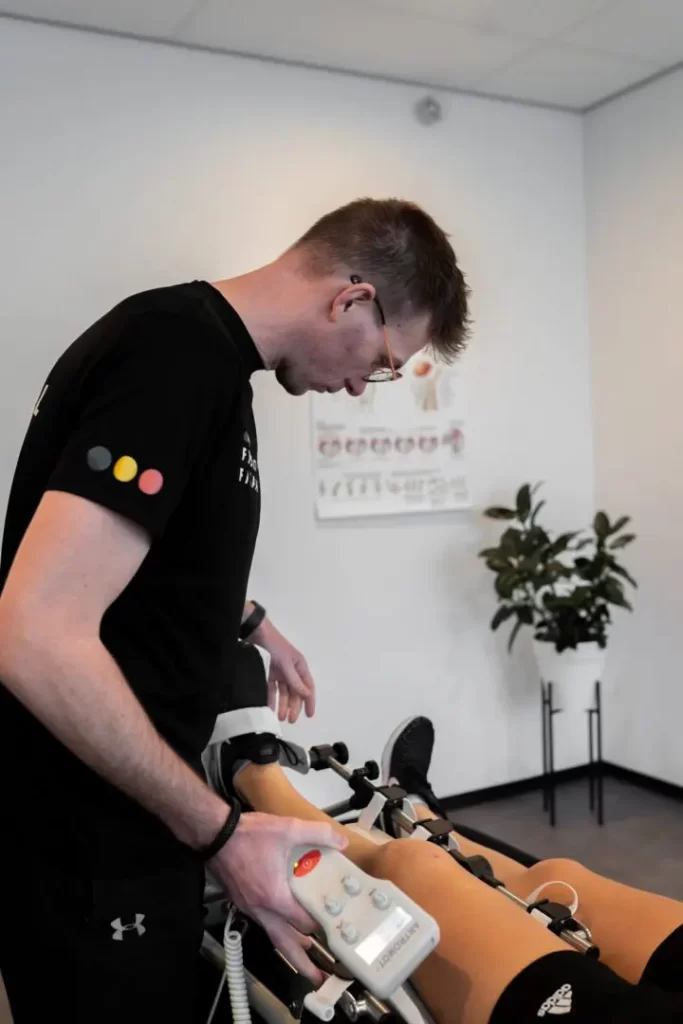
Phase 2 strength building and load capacity
Once walking improves, swelling subsides and the knee shows more control, rehabilitation shifts to strength and stability. This is often the phase when people already feel a lot better, but this is precisely when most underestimates occur. Less pain does not yet mean that the knee is ready for unexpected rotational movements or sports loads.
The focus is now on muscle strength of thigh, glutes and hamstrings, as well as balance, coordination and trunk stability. You re-learn to properly control the knee specific movement patterns. Think squats, split squats, step-ups and controlled ankle-leg exercises.
A lot is also happening here mentally. After a cruciate ligament injury, confidence is not a given. Many patients feel tension when turning, slowing down or taking an unexpected step. This makes sense. A good course therefore looks not only at strength, but also at movement quality and the feeling of security in the knee.
When to run or jump after anterior cruciate ligament surgery
This depends on certain criteria, not time. In most trajectories, running comes into the picture only when the knee remains calm, strength has recovered sufficiently and you move stably during a bony load. If someone still collapses with the knee inward or does not provide sufficient strength on landing, the step to running is simply too early. There are also clear norm values for this that have been well researched.
Phase 3 Return to run and return to jump
In this phase, training shifts from basic control to dynamic control. Running, accelerating, braking, jumping and landing gradually return. This demands more from the knee joint, but also from tendons, muscles and the central nervous system. The knee must not only be strong, but also able to react quickly.
From here, you can also see why a structured approach is so important. A person can jog straight ahead just fine, but still not have sufficient control in lateral movements or rotation. Especially in sports like football, handball, padel or skiing, that difference is crucial. So returning to sport requires more than just strength building.
From walking to jumping: a gradual build-up
The phase begins with running. How does the knee function under shock loading? Is there symmetry between both legs? Is the load distributed properly? Only when the running pattern is stable and symmetrical does it make sense to increase the intensity.
From a good running pattern, training is extended to include acceleration, braking and directional changes. These are movements that occur in almost every sport and demand considerably more from the knee than straight running. The nervous system must learn to adjust quickly and automatically, something that requires time and repetition.
The next step is jumping and landing. This is often the most demanding part of the phase. Upon landing, great force comes to bear on the knee, hip and ankle in a split second. The technique - how you position your leg, how you absorb the force - is at least as important as the force itself. We start with simple, two-legged jumps and gradually build up to one-legged and with rotation.
Training often becomes more intense and specific during this phase. Landing mechanics, direction changes, acceleration and braking play a greater role. Force differences between left and right also become more critical. As long as the affected leg clearly lags behind, the risk of a new injury remains higher.
We work with set measuring points to assess whether someone is ready for the next step. We do this using functional tests and strength comparisons between both legs. Not a date on the calendar, but the outcome of those measurements determine the pace of the build-up.
Phase 4 Return to sport, return to play
The final phase is all about returning to your end goal. For some, that is working pain-free again on construction sites, for others a half-marathon or returning to the football pitch. These goals require different load capacities. Therefore, there is no standard end point that is the same for everyone.
In sports rehabilitation, it is not only important whether you can perform the exercises properly, but also whether you can do so under fatigue, speed and unexpected situations. A knee that feels stable in the exercise room should also be so in competitive situations. Therefore, jump tests, strength measurements and functional tests are often used in this phase to assess whether the next step is justified.
A common mistake is to fully return too soon because daily life is already going well again. It is precisely at this stage that patience is often decisive for lasting results. Those who want to return too soon often sacrifice control. And control is exactly what an anterior cruciate ligament needs under high stress.
How long does recovery take after anterior cruciate ligament surgery?
This is the point where many people want a tight answer, but recovery is not a stopwatch. After anterior cruciate ligament reconstruction, a full course often takes a full year to 18 months. With complex injuries, cartilage damage, meniscus repair or anxiety with movement, that can increase.
More important than the end date is the quality of the build-up. Rapid rehabilitation that skips important intermediate steps is out of date. Then the gains seem great at first, but you get bogged down later in pain, uncertainty or a new injury. A good course opts for progress that is sustainable.
Rehabilitation with criteria
Within anterior cruciate ligament rehabilitation phases, you ideally look at a combination of factors. Time since surgery plays a part, but is never enough on its own. The knee should respond calmly to load, mobility should be sufficient and muscle strength should demonstrably recover.
In addition, movement quality and confidence are indispensable. Someone who jumps technically well but holds tension on every landing is not yet ready for full sports situations. The same applies vice versa: a lot of self-confidence without objective strength and control is not a good basis either. It is precisely the combination of measuring, observing and experiencing that makes our rehabilitation so strong.
At Fysio Fitaal, this fits well within a structured approach in which you first get the basics right, then build up in a focused way and finally test whether you are really ready to continue on your own.
Why rehabilitation after a cruciate ligament injury is so often underestimated
An anterior cruciate ligament injury is not simply a ligament that breaks. You also lose muscle function, timing, stability and often a piece of confidence. Certainly athletes find that the body does not automatically do what it did before. This requires training that goes beyond just getting stronger.
This is why a standard approach does not work. The right exercise at the wrong time is still the wrong choice. Training too lightly gives insufficient incentive, training too heavily leads to irritation and relapse. Good coaching makes that difference visible and adjusts before complaints build up.
Pitfalls in anterior cruciate ligament rehabilitation
The biggest pitfall is impatience. As soon as the pain subsides, many people want to return to normal functioning. This is understandable, but tissue repair, muscle recovery and motor control do not always run in parallel. So you can feel better than your knee is actually taxable.
A second pitfall is training too one-sidedly. Exercising only strength is not enough, nor is doing only stability exercises. Complete rehabilitation combines mobility, strength, coordination, building impact and sport-specific stimuli.
Ignoring knee reaction is also common. Swelling, stiffness the next morning or loss of extension are signs that the load was not optimal. Those who react to this in time often prevent larger relapses.
Stronger from anterior cruciate ligament rehabilitation
Really take plenty of time for your rehabilitation and don't think of it as waiting. Work consistently, keep track of how your knee reacts and ask questions if something is unclear. Precisely patients who understand why they are going through a certain phase usually build up calmer and stronger.
In addition, keep looking at the bigger picture. Sleep, general fitness, stress and diet affect recovery more than many people think. A knee does not recover in isolation from the rest of your body. Those who want a sustainable return to sport or work must therefore think more broadly than just the injury itself.
The best rehabilitation doesn't feel like gambling, but a plan with clear steps, measurable progress and room to adjust. That not only gives you a stronger knee, but also more confidence in what your body can handle again. And that's exactly where real recovery begins.