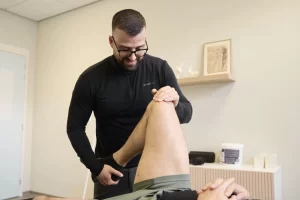
Hip Exorotation Lateral position
Purpose of the exercise
Focuses on strengthening the deep hip rotators and gluteus medius, with additional activation of the core. Improves hip stability, pelvic control and hip and knee alignment. Supports injury prevention and movement quality in walking, standing and athletic movements.
Supplies
Starting position
-
Lie on your side
-
Lower arm supports the head
-
Hips and shoulders stacked
-
Knees bent at about 90 degrees
-
Feet together
-
Core slightly tightened
Implementation
-
Open the upper leg by moving the knee upwards
-
Keep feet together
-
Move from the hip, not the torso
-
Get to a comfortable final position
-
Actively tighten the glutes
-
Lower the knee slowly and in a controlled manner
-
Maintaining trunk and pelvic stability
-
Change of sides after completion
Points of interest
✓ Keep hips and shoulders stacked
✓ Move in a controlled manner without momentum
✓ Pelvis remains stable
✓ Breathe calmly and evenly
✓ Focus on tension in the glutes
✗ Rolling or tilting backwards
✗ Swinging the upper leg
✗ Too much movement without control
✗ Offsets from lower back
✗ Ignoring pain in hip or lower back
When this exercise?
Hip exorotation side-lying is used to improve hip stability and control, especially in cases of reduced activation of the gluteal muscles or instability of the pelvis. The exercise is very suitable within rehabilitation after hip, knee or lower back injuries, but also preventively to improve movement quality.
In addition, this exercise can be used as an activation or support exercise within sports and strength programmes, for example prior to heavier hip or leg exercises. Due to the low load, the exercise can be applied well in different phases of training and recovery. Application and progression should always take place in consultation with a physiotherapist or other qualified professional, so that the exercise is tailored to individual load capacity, symptoms and recovery status.
 Nederlands